



Polyurethane Foam Spray Machine: High-Pressure, Low Waste?
Polyurethane Foam Spray Machine: High-Pressure, Low Waste?
What to Really Look for in a polyurethane foam spray machine in 2025
I’ve spent more jobsite mornings than I can count watching crews fiddle with hoses and pressure dials while the sun comes up. Honestly, the right gear pays for itself in fewer callbacks and way calmer operators. If you’re weighing a polyurethane foam spray machine purchase this season, here’s the straight talk—trends, specs, and a couple of real-world lessons.
Industry snapshot
Two things are shaping buys right now: low-GWP blowing agents (HFOs) and tighter energy codes. That means higher mix precision, smarter temperature control, and data logging are becoming standard. I’m also seeing more battery or hybrid rigs on remote projects—surprisingly capable, though runtime still varies in the cold.
How the machines really work
At the core, you’ve got isocyanate (A) and polyol/resin (B) metered at a fixed 1:1 (usually) and smashed together via impingement mixing in the gun. Heat and pressure stability are everything. In practice, a dependable polyurethane foam spray machine holds ±1–2% on ratio, keeps hose temp within a couple degrees, and doesn’t drift when the operator speeds up on long pulls.
Process flow (field-proven)
- Materials: A-side ISO; B-side polyol blend with HFO/HFC; target density 30–45 kg/m³ for insulation.
- Prep: ISO dry air per ISO 8573-1; strainers cleaned; drum temps stabilized around 21–27°C.
- Method: Pressure ≈ 90–140 bar; hose heat ≈ 45–65°C; spray in lifts meeting local code (often ≤50 mm per pass).
- Testing: Core density ASTM D1622; adhesion ASTM D4541; surface burn ASTM E84; viscosity check ISO 2555.
- Service life: Pumps/hoses 3–5 years typical; heater cores 5–8 years with maintenance; full system 7–10 years in normal duty.
- Industries: Building envelope, roofing, cold chain panels, truck bodies, marine flotation, and automotive NVH fill.
Typical machine specs (real-world values may vary)
| Mix ratio | Fixed 1:1 (±1–2%) |
| Max output | ≈ 4–9 kg/min (depends on formulation and temp) |
| Max working pressure | ≈ 140–210 bar |
| Hose length | 15–90 m heated, ΔT control ±2°C |
| Heater capacity | 6–12 kW, staged |
| Power | 230V 1Φ or 400V 3Φ options |
| Certifications | CE/UKCA; manufacturer QMS ISO 9001 |
Vendor comparison (summarized)
| Vendor/Model | Strengths | Watch-outs | Price Band (≈) |
|---|---|---|---|
| Graco Reactor E/XP series | Global support, stable heaters, strong data logging | Premium pricing; proprietary parts | High |
| PMC PH/PM series | Robust pumps, straightforward maintenance | UI less polished; spares lead times vary | Mid–High |
| Select OEM (China/EU) | Value pricing; customizable configs | Support network uneven; verify CE scope | Mid |
Related equipment: Die Changing Car for fast mold swaps
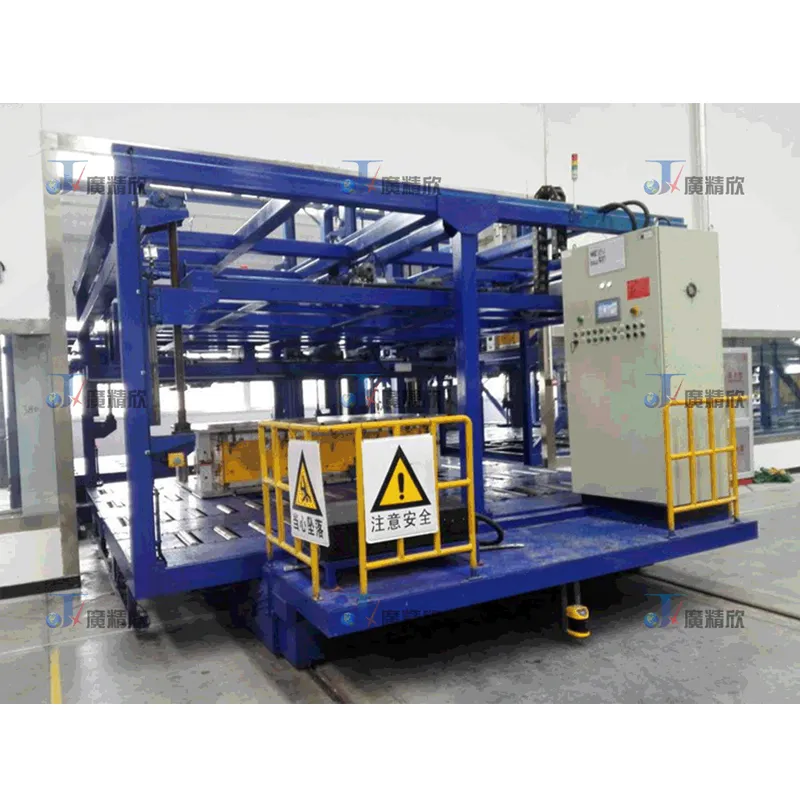
On integrated foam lines (panels, auto parts), changeover kills throughput. A neat fix I’ve seen is the Die Changing Car from HeadliningLine, built in Chongqing (No.398, Qianxing Road, Qiantang Town, Hechuan District, P.R.C). It uses an A-frame with ground track, ball-screw lift driven by a DC motor, and on-board batteries—so no slide-wire install. Each mold has an electronic ID for quick recognition, and operators literally do one-key mold replacement. Many customers say it cut downtime more than they expected. Pairing that with a stable polyurethane foam spray machine keeps takt time shockingly consistent.
Customization and QA
- Options: anti-static heated hoses, explosion-proof enclosures, recipe locking, and cloud job logs.
- QA checklist: ratio check (bucket test), daily strainers, weekly desiccant replacement, monthly calibration.
- Docs to ask for: CE declaration of conformity scope, electrical schematic, spare parts list, and operator training certs.
Mini case notes
A roofing crew in a coastal region switched to a mid-range polyurethane foam spray machine with better hose temp control and reported 18% less overspray on windy days—mostly from more consistent atomization. Another cold-chain panel plant added an electronic-ID mold cart; changeover fell from 40 to about 12 minutes, and scrap dipped because of fewer misaligned molds.
Safety and standards
Don’t skimp: full-face air-purifying respirators or supplied air per OSHA 1910.134; ventilation matched to iso exposure; and confirm foam meets ASTM E84 where required. For materials QC, ISO 2555 viscosity checks keep you out of trouble.
Citations
- ASTM E84 Surface Burning Characteristics of Building Materials.
- ASTM D1622 Standard Test Method for Apparent Density of Rigid Cellular Plastics.
- ISO 2555 Plastics — Resins in the liquid state — Determination of apparent viscosity.
- OSHA 29 CFR 1910.134 Respiratory Protection.
- CE Machinery Directive 2006/42/EC and related harmonized standards.