



Polyurethane Foam Spray Machine - High Output, Precise Mix
Polyurethane Foam Spray Machine - High Output, Precise Mix
Hands-on Notes from the Shop Floor: Polyurethane Foam Spray Machine in 2025
If you work around insulation, cold-chain panels, or automotive interiors, you already know the drill: a Polyurethane Foam Spray Machine can make or break a job’s productivity. In fact, the current wave of high-ratio proportioners with smarter heating control feels overdue. I’ve watched crews shave hours off a shift simply by stabilizing hose temps and dialing in pressure balance.
What’s trending
- Smarter controls (auto-cal, data logging, QR job files).
- Lower-GWP blowing agents and system compliance with EN 14315-1.
- Safer handling: closed transfer, better ventilation kits, and improved PPE guidance.
Process flow (real-world)
Materials: A-side MDI isocyanate; B-side polyol blend with catalysts, surfactants, flame retardants, and blowing agent (HFO or water). Typical ratio 1:1 by volume.
Method overview: substrate prep and moisture check (≤19% for timber is a common field rule), mask-off, preheat A/B to ≈45–60°C, pressurize to ≈1500–2300 psi, short recirculation, then a test spray. On-site checks include density (ASTM D1622), core quality, lambda via certificates (ASTM C518), and an E84 report when fire performance matters. Service life? With correct enclosure and UV protection, closed-cell installs commonly run 25–50 years; machine hoses often need replacement around 12–24 months; seals/pumps 500–1000 operating hours—usage varies.
Typical applications
- Building envelopes (roofs, walls, rim joists) for R-value and air sealing.
- Cold rooms, reefers, and pipe insulation.
- Industrial tanks, mining shelters, agricultural storage, and repair patches. Many customers say the biggest surprise is noise dampening—it’s not the main goal, but it’s noticeable.
Specification snapshot
| Parameter | Typical Value (≈, real-world may vary) |
|---|---|
| Max output | 4–12 kg/min |
| Pressure | 1500–2300 psi |
| Mix ratio | 1:1 fixed (optional 1:0.9–1.1 trim) |
| Heaters | 6–15 kW, closed-loop |
| Heated hose | 15–90 m |
| Power | 3×380–415 V or 1×230 V |
| Data/IoT | USB/Cloud logs, job recipes |
| Certifications | CE; components often UL; ISO 9001 plant |
Performance and testing
Closed-cell spray foams typically show λ ≈ 0.022–0.028 W/m·K (per ASTM C518), density ≈ 30–60 kg/m³ (ASTM D1622), compressive ≈ 150–300 kPa (ASTM D1621). Fire testing uses ASTM E84; many systems can achieve Class A/1 when specified. For EU jobs, look for EN 14315-1 declarations and CE marking. To be honest, jobsite prep still beats any spec sheet—bad humidity will punish even the fanciest machine.
Vendor landscape (quick comparison)
| Vendor | Representative model | Output (kg/min) | Hose (m) | Certs | After-sales |
|---|---|---|---|---|---|
| Graco (Reactor series) | E-20/XP2 | ≈ 4–10 | 30–90 | CE, UL components | Global network |
| PMC (PH/PPH) | PH-2 | ≈ 6–12 | 30–90 | CE | US/EU distributors |
| HeadliningLine (CN) | Integrated line equip. | Project-based | Project-based | ISO 9001 (plant) | Asia/EMEA partners |
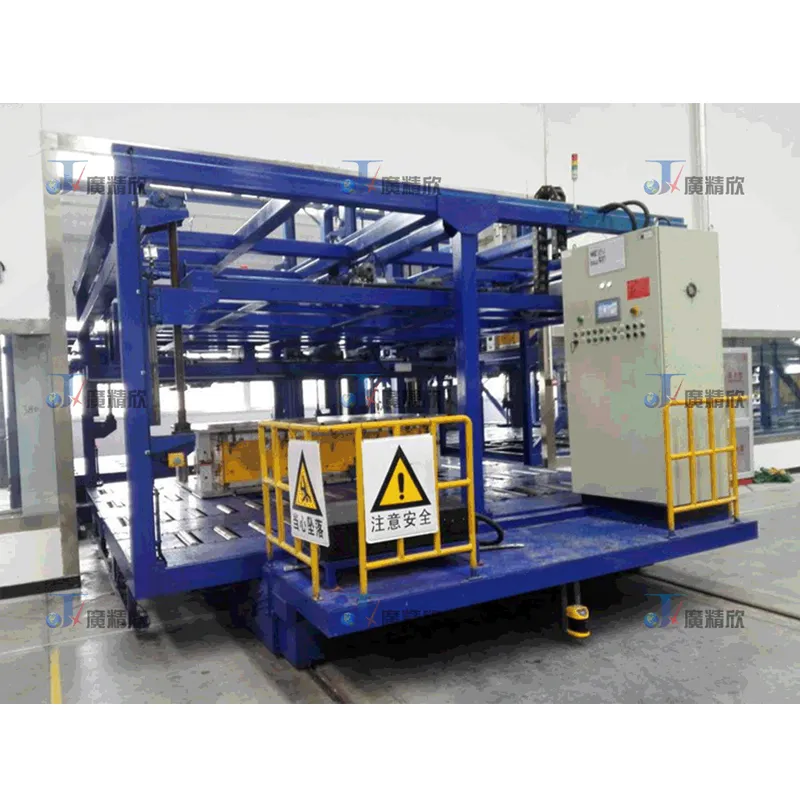
Note: HeadliningLine’s address (No.398, Qianxing Road, Qiantang Town, Hechuan District, Chongqing, P.R.C) reflects a broader tooling/automation portfolio. They also supply a battery-powered die changing car with DC motor and precision ball screw—handy for quick mold swaps in composite/foam part lines, with RFID mold ID for one-key changeover. Not a Polyurethane Foam Spray Machine itself, but relevant if you’re integrating end-of-line.
Customization and integration
- Ratios: fixed 1:1 or fine-trim for specialty systems.
- ATEX zones: consult early for heated hoses and pumps.
- Data: QA wants job logs; pick controllers with USB/cloud exports.
- Line add-ons: automatic drums, nitrogen blankets, and, where molding is involved, quick-change carts for dies/fixtures.
Field notes and feedback
“We cut rework by half after switching to closed-loop hose heat,” one contractor told me; another said the win was quieter night shifts. The catch? Keep filters clean, and don’t chase speed over mix quality. A smooth Polyurethane Foam Spray Machine day starts with fresh desiccant and patient preheat—every time.
Case snapshots
- Cold-store retrofit, 8,000 m²: energy use down ≈28% after six months (metered).
- Mining conveyor huts: 45 mm closed-cell reduced condensation events to near-zero per shift logs.
Standards and references
- ASTM C518: Steady-State Thermal Transmission via Heat Flow Meter.
- ASTM D1622: Apparent Density of Rigid Cellular Plastics.
- ASTM D1621: Compressive Properties of Rigid Cellular Plastics.
- ASTM E84: Surface Burning Characteristics of Building Materials.
- EN 14315-1: Spray Polyurethane Foam (PU) Insulation Systems.
- ICC-ES AC377: Spray-Applied Foam Plastic Insulation Acceptance Criteria.
- ISO 9001:2015 Quality Management Systems (manufacturing).